
Anyone who installs steel pipes for heating, water, or gas will eventually need to cut a pipe thread. Before making the first cut, a few questions need clear answers: What type of thread does the fitting need? What is the actual diameter of a 3/4″ pipe? Which tool is best for the number of threads and work area?
This guide explains the three most common pipe threads (BSPT, BSPP, and NPT), shows how to convert inch sizes to actual pipe diameters, and compares three methods of cutting a thread: with a hand pipe threader, a portable electric threading machine, or a stationary threading machine. It also covers die heads, chasers, and threading oil.
What types of pipe threads are there?
Catalogs and price lists use a few abbreviations to name pipe threads. For example, the CBC chaser sets cover these thread types:
- BSPT (gas tapered): The tapered Whitworth pipe thread is designated "R" for the external thread. It is defined in ISO 7-1 and the European standard EN 10226, which replaced DIN 2999.
- BSPP (gas cylindrical): The parallel Whitworth pipe thread with the designation G, according to ISO 228-1.
- NPT (National Pipe Taper): the tapered National Pipe Thread according to ASME B1.20.1. It is the standard pipe thread in North America, whereas most other countries use the Whitworth pipe thread.
- Whitworth (BSW) and metric (MA) are not pipe threads in the strict sense, but many threading machines cut them with matching chasers, such as the CBC 392-N, 392-L, and 600, which can be used on solid bars.
Tapered or parallel: where the joint seals
Both BSPT and NPT are tapered, with a diameter change of 1 in 16 along the thread. When the joint is tightened, the flanks press against each other to create a seal on the thread itself. In practice, however, a sealant is still used, such as PTFE tape, hemp, or a thread sealing compound. Jointing threads to ISO 7-1 always have a tapered external thread, and the internal thread can be either tapered (Rc) or parallel (Rp).
A parallel G thread does not seal on the thread. In this case, a flat gasket, an O-ring, or a metal sealing face is used to make the joint tight.
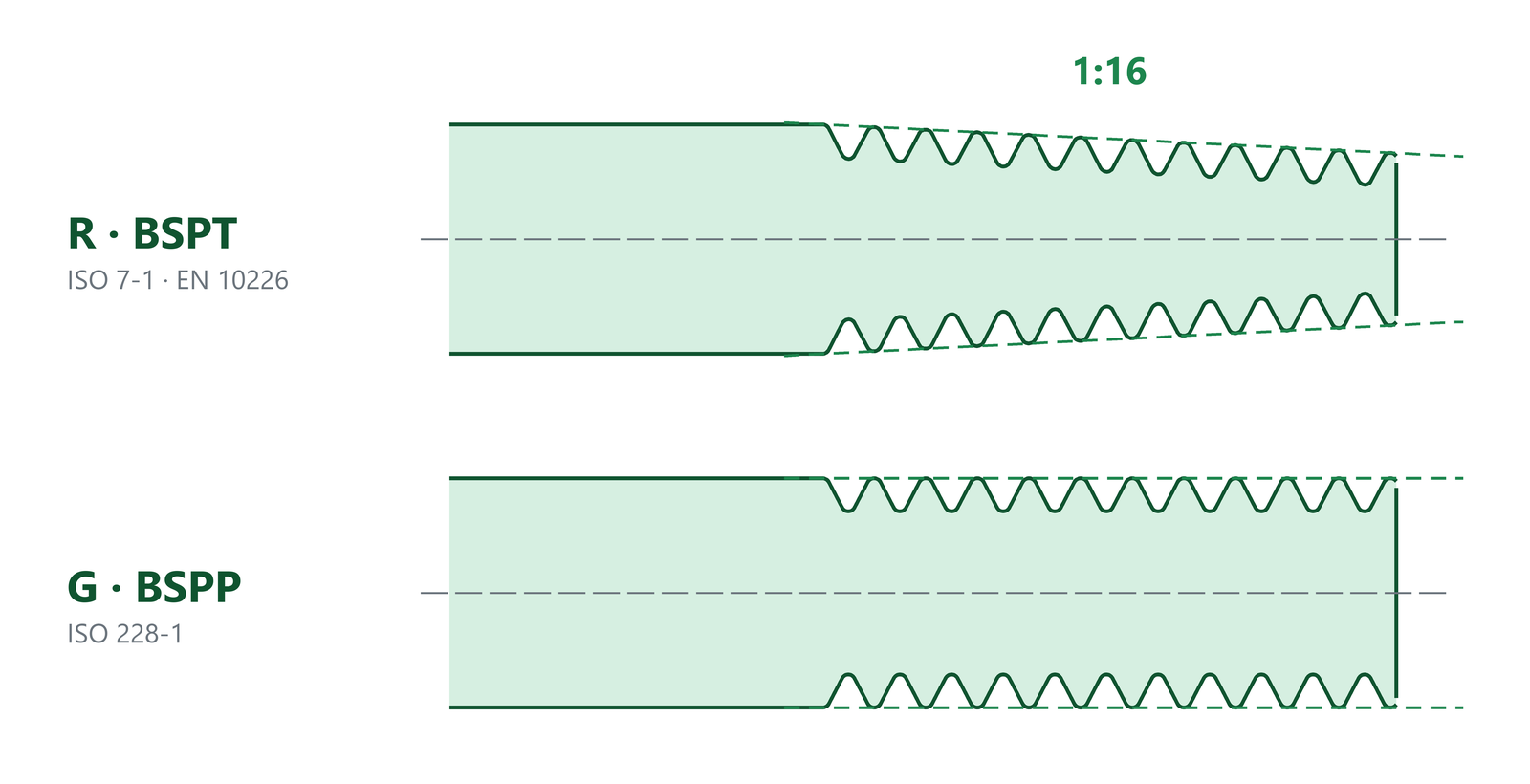
BSPT and NPT are not interchangeable
Both threads have a 1:16 taper and 14 threads per inch at 1/2″ and 3/4″. However, the thread form differs: the Whitworth pipe thread has a flank angle of 55° and rounded crests; the NPT has an included angle of 60° and flat crests. The pitch differs as well from 1″: 11 threads per inch for BSP and 11.5 for NPT. From 2.5″, it is only 8 for NPT. Therefore, each thread type needs its own chasers or threading heads. CBC lists BSPT and NPT as separate versions.
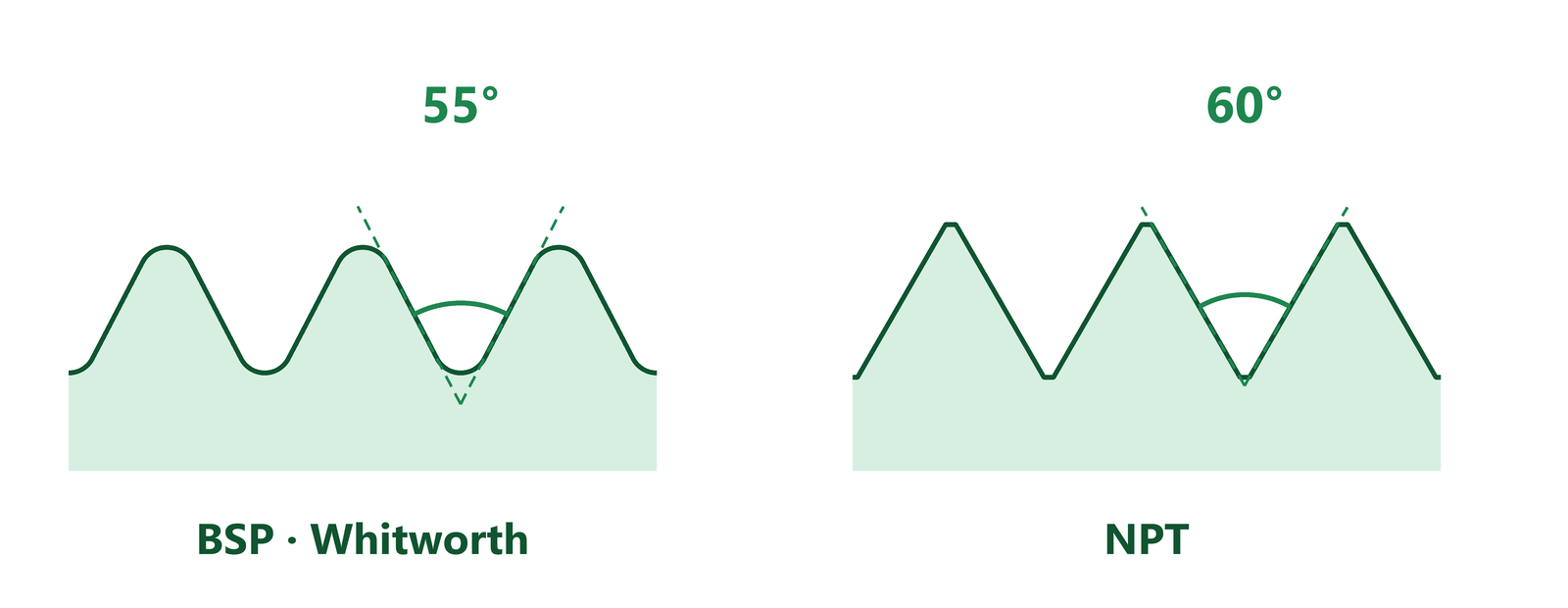
Inch Sizes: What Does 1/2" Really Mean?
The size of a pipe thread in inches is a nominal size, not an actual measured diameter. Originally, it referred to the inside diameter of a steel tube, but today, it does not match either the inside or outside diameter. For example, a 1/2-inch steel pipe has an outside diameter of 21.3 mm, while a 2-inch pipe has an outside diameter of 60.3 mm. The table below lists common sizes and their thread pitch in both systems.
| Size | Pipe outside diameter | Threads per inch BSP | Threads per inch NPT |
|---|---|---|---|
| 1/4″ | 13.5 mm | 19 | 18 |
| 3/8″ | 17.2 mm | 19 | 18 |
| 1/2″ | 21.3 mm | 14 | 14 |
| 3/4″ | 26.9 mm | 14 | 14 |
| 1″ | 33.7 mm | 11 | 11 1/2 |
| 1 1/4″ | 42.4 mm | 11 | 11 1/2 |
| 1 1/2″ | 48.3 mm | 11 | 11 1/2 |
| 2″ | 60.3 mm | 11 | 11 1/2 |
| 2 1/2″ | 76.1 mm | 11 | 8 |
| 3″ | 88.9 mm | 11 | 8 |
| 4″ | 114.3 mm | 11 | 8 |
| 5″ | 139.7 mm | 11 | 8 |
| 6″ | 168.3 mm | 11 | 8 |
The table shows the outside diameters of steel pipes with a Whitworth pipe thread. American pipes with NPT threads have slightly different outside diameters. This difference is particularly noticeable at 2.5″ (73.0 mm) and 5″ (141.3 mm).
Three ways to cut a pipe thread
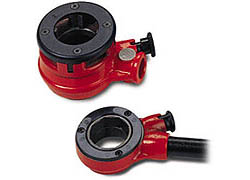
Hand threader
CBC FM-ECO, 3/8″ – 2″
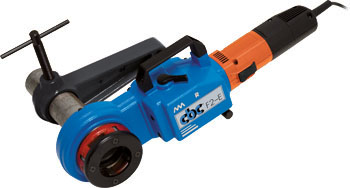
Portable machine
CBC F2-E, 1/4″ – 2″
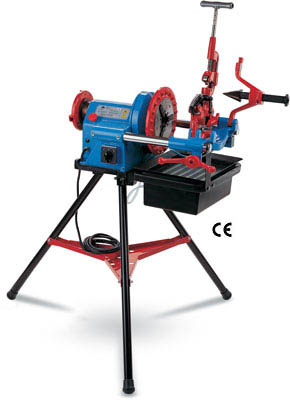
Stationary machine
CBC 220, 1/4″ – 2″
Hand pipe threader with ratchet
For occasional use, a hand threader is sufficient and does not require a power supply. The CBC FM-ECO hand pipe threader consists of a ratchet with a handle and threading heads with their respective chasers; one head is provided for each pipe size. The set covers 3/8" to 2" BSPT. Heads up to 1 1/4" fit into the smaller ratchet and the 1 1/2" and 2" heads fit into the larger one. The complete set, which includes seven heads and a metal case, weighs 13.7 kg. For larger pipes or many threads, a motorized machine is a more practical choice.
Portable electric threading machine
Portable machines use the same type of threading heads, but they are powered by an electric motor. The CBC 114 MINI weighs 4.6 kg and threads from 1/4″ to 1 1/4″ at 30 rpm. The CBC F2-E weighs 6 kg, has a 1000 W motor, and can reach 2″. Both run on 230 V. Their standard sets include a case and a pipe clamp with swivel support. The 114 MINI can also be mounted on a plumber's stand, which is useful when cutting threads directly where the pipe is installed.
Stationary threading machine
A threading machine clamps the pipe and cuts the thread with a die head. Depending on the design, it can also cut the pipe to length and deburr it in the same setup. A pump supplies oil to the chasers while they are cutting. CBC builds two designs.
- With pipe cutter and deburrer on the tool carriage: the compact CBC 352 (35 kg, 1/8″ to 2″), the CBC 220 on a folding stand, the CBC 230 with a second die head up to 3″ and the CBC 440 for 1/4″ to 4″, which CBC describes as a construction site machine on a trolley with tool cabinet.
- With rotating head and self-centering vice: the vice feeds the pipe or a solid bar into the die head. This applies to the CBC 392-N and CBC 392-L up to 2″, the CBC 600 with two heads up to 4″ and the CBC 620/E for 2″ to 6″.
The overview compares the tools by BSPT range, drive and weight:
| Tool | BSPT range | Drive | Weight |
|---|---|---|---|
| FM-ECO | 3/8″ – 2″ | hand ratchet | 5.8 – 13.7 kg (set) |
| 114 MINI | 1/4″ – 1 1/4″ | 230 V, 900 W | 4.6 kg |
| F2-E | 1/4″ – 2″ | 230 V, 1000 W | 6 kg |
| 352 | 1/4″ – 2″ | 230 V, 1500 W | 35 kg |
| 220 | 1/4″ – 2″ | 230 V, 1500 W | 55 kg with stand |
| 230 | 1/4″ – 3″ | 230 V, 1500 W | 60 kg with stand |
| 440 | 1/4″ – 4″ | 230 V or 400 V | 250 kg with trolley |
| 392-N | 1/4″ – 2″, also bars | 230 V or 400 V | 95 kg |
| 392-L | 1/4″ – 2″, also bars | 400 V | 175 kg |
| 600 | 1/4″ – 4″, also bars | 230 V or 400 V | 265 kg |
| 620/E | 2″ – 6″, also bars | 400 V | 430 kg |
With the adapter Mod. 97, the 114 MINI, F2-E, 352, 220 and 230 also thread 2 1/2″ to 4″.
Beyond 2 inches: the adapter Mod. 97
A larger diameter does not necessarily require a larger machine. The CBC adapter Mod. 97 can be mounted on the 114 MINI, F2-E, 352, 220, or 230. A support is made for each machine, and the adapter threads gas pipes from 2.5″ to 4″. It is available in BSPT or NPT. For the Mod. 97/RAP, the head releases with a single movement at the end of the thread and returns to its starting position. For those who only occasionally need 4″ threads, the adapter is an alternative to a 4″ machine, such as the 440 or 600.
Die heads and chasers
The chasers cut the thread, and the die head holds and sets them to the desired thread size. There are two designs.
- Self-opening die heads automatically open when the threading is finished. Most CBC threading machines use this design.
- Manual opening die heads must be opened by hand. Examples include the 352/R and the 440 for 2 1/2″ to 4″.
Chasers are sold as sets for a specific size range and thread type. Before ordering, check the following three points:
- Thread type: BSPT, BSPP, NPT, metric, and Whitworth each require their own set.
- Pipe material: CBC offers HSS chasers for stainless steel pipes.
- Direction: Left-hand threads require left-hand chasers and a left-hand die head.
The chasers on the hand threader and portable machines are fixed in a separate ECO threading head for each size: BSPT from 1/4″ to 2″, NPT from 3/8″ to 2″. For the stationary machines, CBC lists the die heads and the chaser sets per machine.
Threading oil and lubrication
Threading machines continuously lubricate the chasers: the 352, 220, 230, 440, and 600 models have a built-in gear pump; the 392-N, 392-L, and 620/E models have a built-in tank in a closed circuit. With hand threaders and portable machines, the oil is applied directly. The standard F2-E set includes a 600-ml spray can.
CBC Hydrocut SL is a non-mineral threading fluid for use with ferrous materials and stainless steel. CBC highlights its stability, EP properties, and high biodegradability and recommends it for plumbing, heating, and sanitary installations. It comes in cartons of six 5-liter containers or 24 1-liter containers.
Step by step: cutting a pipe thread
- Cut to length: cut the pipe square, with a pipe cutter for steel pipes or the cutter of the threading machine.
- Deburr: remove the burr inside the pipe; threading machines have a deburrer on the tool carriage.
- Clamp: hold the pipe securely – in a pipe vice, in the pipe clamp of the portable machine or in the threading machine itself.
- Check the tool: thread type, size and direction of the chasers must match the fitting.
- Cut the thread: keep the chasers lubricated with threading oil; a self-opening die head opens automatically at the end.
- Seal and assemble: clean the thread, wrap tapered threads with PTFE tape or hemp and screw the joint together. The CBC Tenditeflon makes winding the tape easier.
Which tool for which job?
- A few threads up to 2″, no power on site: hand pipe threader FM-ECO.
- Regular threads on site: 114 MINI up to 1 1/4″ or F2-E up to 2″, with the Mod. 97 also up to 4″.
- Workshop up to 2″: the compact 352 or the 220 on its folding stand; up to 3″ the 230.
- Larger installations up to 4″: the 440 on its trolley with tool cabinet.
- Pipes and solid bars, also metric: 392-N, 392-L or 600; for 2″ to 6″ the 620/E.
All products are listed in the shop categories hand pipe threaders, portable threading machines, threading machines and accessories and lubricants.
FAQ: cutting pipe threads
What is the difference between BSPT and BSPP?
BSPT is tapered and seals on the thread, typically requiring additional materials such as PTFE tape or hemp. BSPP is parallel (designation G) and requires a gasket, O-ring, or sealing face for a tight joint. Both have the same 55° thread form and pitch.
Can I cut NPT threads using BSPT chasers?
No, NPT has a 60° thread form and a different pitch from 1″ on up. You need NPT chasers or threading heads. CBC offers these for its threading machines, as well as ECO heads ranging from 3/8" to 2".
What is the outside diameter of a 1/2-inch pipe?
The outside diameter of a 1/2-inch steel pipe is 21.3 mm. The inch measurement is nominal and does not correspond to the pipe's actual diameter.
Can stainless steel pipes be threaded?
Yes. CBC offers chasers made of high-speed steel (HSS) for stainless steel pipes, and the Hydrocut SL is also suitable for stainless steel. You can find more information about the properties of the different materials in our guide pipe materials – an overview.
Which machines can cut threads up to four inches?
The CBC 440 and CBC 600 can thread up to 4 inches directly. The 114 MINI, F2-E, 352, 220, and 230 reach from 2.5 to 4 inches with the Mod. 97 adapter. CBC builds the 620/E for 2″ to 6″.